
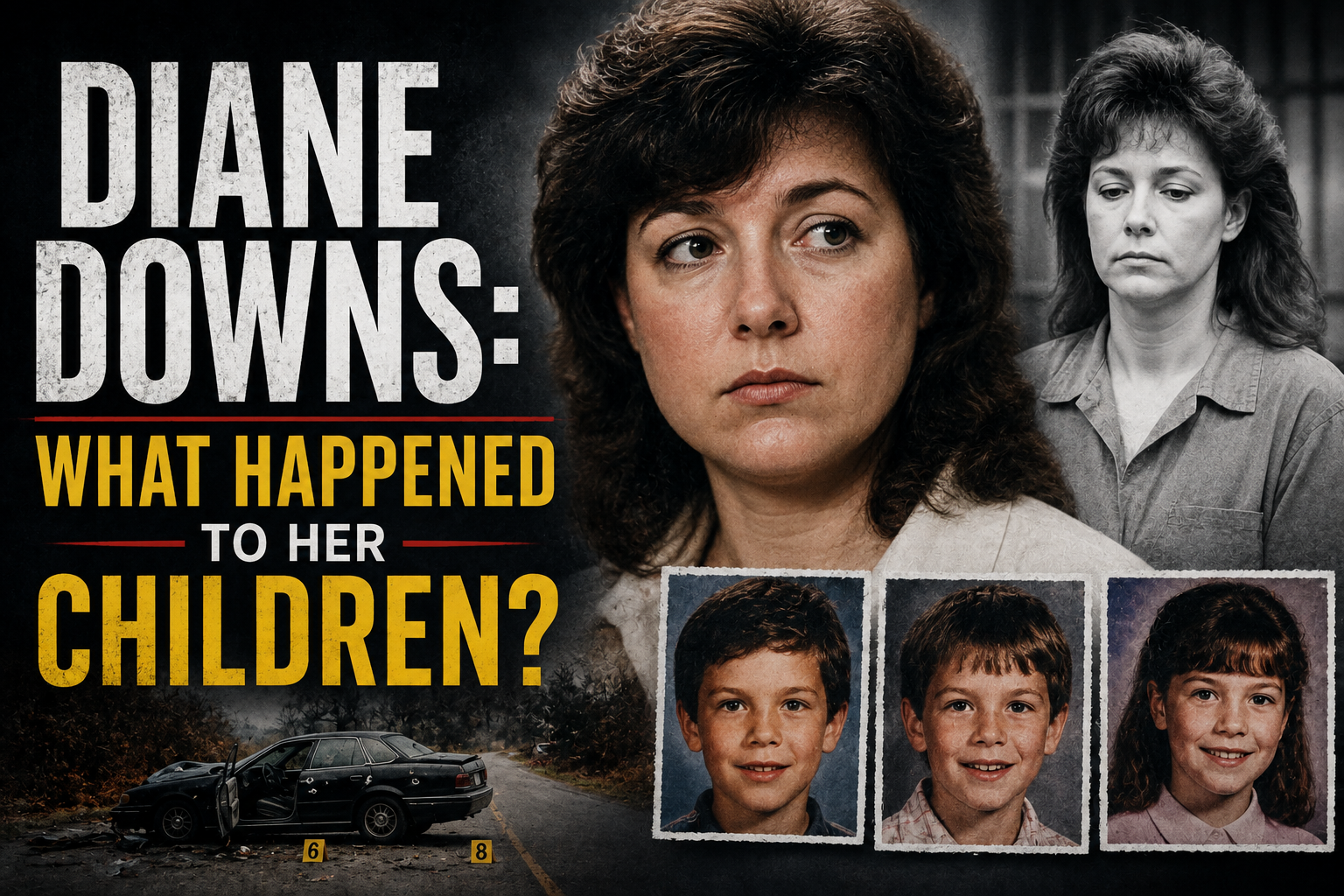
Diane Downs: What Happened to Her Children?
The case of Diane Downs remains one of the most disturbing criminal cases in modern American history because it began with a mother’s claim that a stranger had attacked her family. On May 19, 1983, Downs arrived at a hospital near Springfield, Oregon, with her three children after a shooting. Her daughter Cheryl died, while Christie and Danny survived with severe injuries. Downs herself had also been shot in the arm.
At first, Downs told authorities that an unknown man had attacked the family. Investigators eventually rejected that account, and the case developed into a murder prosecution that attracted national attention.
The question “What happened to Diane Downs’ children?” is central to understanding the case. One child died from her injuries, while the two survivors faced lifelong physical and emotional consequences. Their testimony and recovery also became important parts of the prosecution’s case.
This article examines what happened to each of Downs’ children, the evidence presented at trial, the conviction that followed, and what is publicly known about the surviving children today.
Key Takeaways
- Diane Downs was convicted in 1984 of murdering her daughter Cheryl and attempting to murder her other two children, Christie and Danny.
- Cheryl, age seven, died from the shooting on May 19, 1983.
- Christie and Danny survived but suffered serious injuries.
- Christie later testified that her mother was responsible for the shooting, becoming a crucial prosecution witness.
- Downs received a life sentence plus 50 years and has remained incarcerated.
- Christie and Danny were later adopted and have generally maintained private lives as adults.
- Downs also had another daughter, born shortly after her 1984 trial, who was adopted and later became publicly known as Rebecca Babcock.
Biography Table
| Detail | Information |
|---|---|
| Full Name | Elizabeth Diane Downs |
| Date of Birth | August 7, 1955 |
| Age | 71 in 2026 |
| Birthplace | Phoenix, Arizona, U.S. |
| Nationality | American |
| Profession | Former postal worker |
| Education | Attended Pacific Coast Baptist Bible College |
| Years Active | Primarily known publicly for the 1983 criminal case |
| Known For | The 1983 shooting of her three children and subsequent conviction |
| Major Achievements | Not applicable; primarily known for her criminal conviction |
| Estimated Net Worth | No reliable public estimate |
Downs was born Elizabeth Diane Frederickson in Phoenix, Arizona, in 1955. Public records and biographical accounts identify her as a former postal worker who later became known internationally because of the criminal case involving her children.
What Happened to Diane Downs’ Children?
The shooting occurred on May 19, 1983, near Springfield, Oregon. Downs had three children at the time: Christie, Cheryl and Danny.
According to the subsequent court record, all three children were shot. Cheryl, who was seven years old, died. Christie, eight, and Danny, three, survived but suffered severe injuries. Downs also sustained a gunshot wound to her arm.
The prosecution ultimately argued that Downs herself was responsible for the shooting. Downs maintained a different account, telling authorities that an unknown assailant had attacked the family.
The contrast between those two stories became the foundation of the investigation and trial.
Cheryl Downs Died From Her Injuries
Cheryl Downs was the youngest of the two older girls and was seven years old when she was killed.
After the shooting, Downs drove the children to a hospital. Cheryl’s injuries were fatal, and doctors were unable to save her.
Her death became the murder charge at the center of the subsequent prosecution.
Unlike her siblings, Cheryl could not provide testimony about what had happened inside the vehicle. Investigators therefore had to reconstruct the events using physical evidence, witness observations and information obtained during the investigation.
The loss of Cheryl was also the most tragic outcome of the shooting: a seven-year-old child died as a result of the attack.
Christie Downs Survived and Became a Key Witness
Christie Downs, then eight years old, survived the shooting but suffered catastrophic injuries.
Her recovery was complicated by a stroke that affected her ability to communicate. After extensive medical treatment and rehabilitation, Christie eventually became capable of providing testimony about the incident.
Her testimony became one of the most important elements of the prosecution’s case.
According to the federal appellate court’s later review of the case, Christie testified that she saw her mother open the trunk of the car and shoot the children.
At trial, Christie’s account directly contradicted Downs’ claim that a stranger had attacked the family.
That testimony was particularly significant because the prosecution’s case involved a disputed explanation for what had happened. Christie was not simply providing background information; she was describing what she remembered seeing during the shooting.
Danny Downs Survived With Serious Injuries
Danny Downs was only three years old when he was shot.
He survived, but the injuries left him with permanent physical consequences. Recent reporting has described Danny as partially paralyzed and noted that he has largely stayed out of the public spotlight as an adult.
His survival meant that the shooting did not end with Cheryl’s death. Both surviving children had to live with the physical consequences of what happened.
That distinction is important when discussing the Diane Downs case. The victims were not simply names connected to a famous criminal trial. Christie and Danny were children who survived a violent attack and subsequently had to rebuild their lives.
How Did Investigators Become Suspicious of Diane Downs?
Downs initially described the incident as an attack by a stranger or would-be carjacker.
Investigators, however, identified inconsistencies that caused them to question her account.
One important issue involved Downs’ description of how she drove the children to the hospital. Witness observations suggested that her vehicle had been traveling unusually slowly rather than racing toward medical help, which investigators considered inconsistent with the urgency of her story.
Investigators also learned that Downs had access to a .22-caliber handgun. Although the alleged murder weapon was never recovered, ammunition found at her home had extractor markings that prosecutors linked to cartridge casings associated with the shooting.
Another major development involved information about Downs’ personal life and her relationship with a married man.
Prosecutors argued that her relationship provided a possible motive and that she viewed her children as an obstacle to that relationship. That argument became part of the prosecution’s explanation for why she might have wanted the children out of her life.
Importantly, motive was only one part of the prosecution’s case. The conviction rested on the overall evidence presented to the jury, including Christie’s testimony and physical evidence.
What Happened During the Diane Downs Trial?
The trial took place in Oregon in 1984 and received extensive public attention.
The prosecution presented evidence intended to demonstrate that Downs’ story about a stranger was false. Christie’s testimony was especially important because it offered a direct account from one of the surviving victims.
The federal appellate court later summarized the case as involving Downs’ conviction for murder, attempted murder and assault arising from the shooting of her three children.
On June 17, 1984, the jury found Downs guilty of murder, two counts of attempted murder and two counts of assault.
She was subsequently sentenced to life in prison plus an additional 50 years, with the sentences structured consecutively.
The sentence reflected the seriousness with which the court viewed the crimes.
What Happened to Diane Downs After Her Conviction?
Downs continued to challenge her conviction through the legal system.
Her direct appeal was unsuccessful, and later post-conviction proceedings also failed to overturn the central convictions. A 2000 decision from the U.S. Court of Appeals for the Ninth Circuit describes the procedural history of her challenges and confirms that her Oregon convictions remained in place.
In 1987, Downs briefly escaped from an Oregon women’s correctional facility. She was recaptured after approximately ten days and subsequently transferred out of Oregon.
She has remained imprisoned and has repeatedly sought parole. Recent reporting indicates that she continues to maintain her innocence regarding the shooting.
What Happened to Christie and Danny After the Trial?
After the case, Christie and Danny were removed from Downs’ custody.
They were later adopted by Fred and Joanne Hugi, with Fred Hugi having been involved in the prosecution of Downs. Recent reporting states that both surviving children have generally maintained private lives as adults.
Christie’s Adult Life
Christie eventually built a life away from the intense public attention surrounding her childhood.
Her testimony became permanently associated with the Diane Downs trial, but as an adult she has generally kept her personal life private.
Public reporting indicates that Christie later married and had children of her own.
Her story is especially significant because she survived injuries that doctors initially considered extremely serious and later recovered sufficiently to communicate what she remembered.
Danny’s Adult Life
Danny also survived and has lived with the lasting effects of his injuries.
Recent reporting describes him as partially paralyzed and notes that he pursued a career in technology. Like Christie, he has largely avoided publicity surrounding the case.
That privacy is understandable. The shooting happened when he was only three years old, and much of his childhood became part of a highly publicized criminal investigation.
Did Diane Downs Have Another Child?
Yes.
While Downs was awaiting sentencing after her conviction, she gave birth to another daughter in June 1984. The child was initially named Amy Elizabeth.
The state of Oregon took custody of the baby, who was subsequently adopted and renamed Rebecca Babcock.
Rebecca later learned that Diane Downs was her biological mother.
As an adult, Babcock publicly discussed the complicated experience of discovering her biological connection to Downs. Her story represents another dimension of the case: the long-term consequences did not end with the conviction or imprisonment.
Why Was Christie’s Testimony So Important?
Christie’s testimony carried unusual significance because she was a surviving victim who could describe what she remembered.
The prosecution did not have the recovered murder weapon, and Downs had offered an alternative explanation involving a stranger. In that setting, testimony describing what happened inside the vehicle could be extremely important to a jury.
The Ninth Circuit’s later decision specifically records that Christie testified that she saw Downs shoot the children.
Her testimony therefore helped connect the surviving victim’s account with the physical and circumstantial evidence presented by investigators.
It also helped explain why the jury rejected Downs’ account and convicted her.
Where Is Diane Downs Now?
As of 2026, Diane Downs remains incarcerated.
Recent reporting states that she has continued to seek release through the parole process while maintaining her innocence regarding the shooting.
Her case has also continued to attract public attention decades after the original conviction. Books, television programs, documentaries and renewed reporting have repeatedly examined the investigation and the lives of the children involved.
However, the surviving children have generally chosen a much quieter path.
Diane Downs Case: A Timeline
| Year | Event |
|---|---|
| 1955 | Elizabeth Diane Frederickson is born in Phoenix, Arizona. |
| 1974 | Christie, her first child, is born. |
| 1976 | Cheryl is born. |
| 1980 | Danny is born. |
| 1983 | Downs shoots her three children, according to the prosecution and subsequent conviction. |
| 1983 | Cheryl dies; Christie and Danny survive with serious injuries. |
| 1984 | Downs is arrested and later convicted. |
| 1984 | She receives life imprisonment plus 50 years. |
| 1984 | Her daughter Amy Elizabeth is born and later adopted. |
| 1987 | Downs escapes prison but is recaptured. |
| 2000 | A federal appeals court reviews her habeas proceedings. |
| 2000s–2020s | Downs continues pursuing release while remaining incarcerated. |
| 2026 | Recent reporting confirms that she remains imprisoned. |
The legal history is supported by the Oregon and federal court records, while later developments concerning the family have been reported by major news outlets.
Frequently Asked Questions
What happened to Diane Downs’ children?
Diane Downs’ three children were shot on May 19, 1983. Cheryl, seven, died from her injuries, while Christie, eight, and Danny, three, survived with severe injuries.
Did Christie Downs survive?
Yes. Christie survived the shooting despite suffering life-threatening injuries. After extensive recovery and rehabilitation, she was able to testify at her mother’s trial.
What happened to Danny Downs?
Danny survived the shooting but suffered permanent physical injuries. Recent reporting describes him as partially paralyzed and living a private adult life.
What happened to Cheryl Downs?
Cheryl was seven years old when she was shot on May 19, 1983. She died from her injuries, and her death became the murder charge against Diane Downs.
Was Diane Downs convicted?
Yes. In 1984, Downs was convicted of murdering Cheryl and attempting to murder Christie and Danny. She also received assault convictions and was sentenced to life in prison plus 50 years.
Where are Diane Downs’ surviving children now?
Christie and Danny have largely maintained private lives. Recent reporting says Christie married and had children, while Danny pursued a career in technology and continues to live with the physical effects of his childhood injuries.
Did Diane Downs have another daughter?
Yes. She gave birth to Amy Elizabeth shortly after her 1984 conviction. The baby was adopted and later became known publicly as Rebecca Babcock.
Is Diane Downs still in prison?
Yes. As of 2026, Downs remains incarcerated. Recent reporting indicates that she has continued to seek parole while maintaining her innocence regarding the shooting.
Conclusion
The story of Diane Downs is ultimately a story about three children whose lives were permanently changed by the events of May 19, 1983.
Cheryl Downs lost her life at just seven years old. Christie survived devastating injuries and later became a crucial witness against her mother. Danny also survived but has lived with lasting physical consequences. Both surviving children were eventually adopted and have largely chosen to live outside the public spotlight.
Diane Downs was convicted in 1984 and sentenced to life in prison plus 50 years. Her conviction has survived subsequent legal challenges, and she remains incarcerated decades later.
Understanding what happened to Diane Downs’ children requires looking beyond the sensational aspects of the case. The lasting significance lies with the victims themselves: one child whose life was cut short and two survivors who had to rebuild their lives after an event that became one of Oregon’s most widely known criminal cases.