
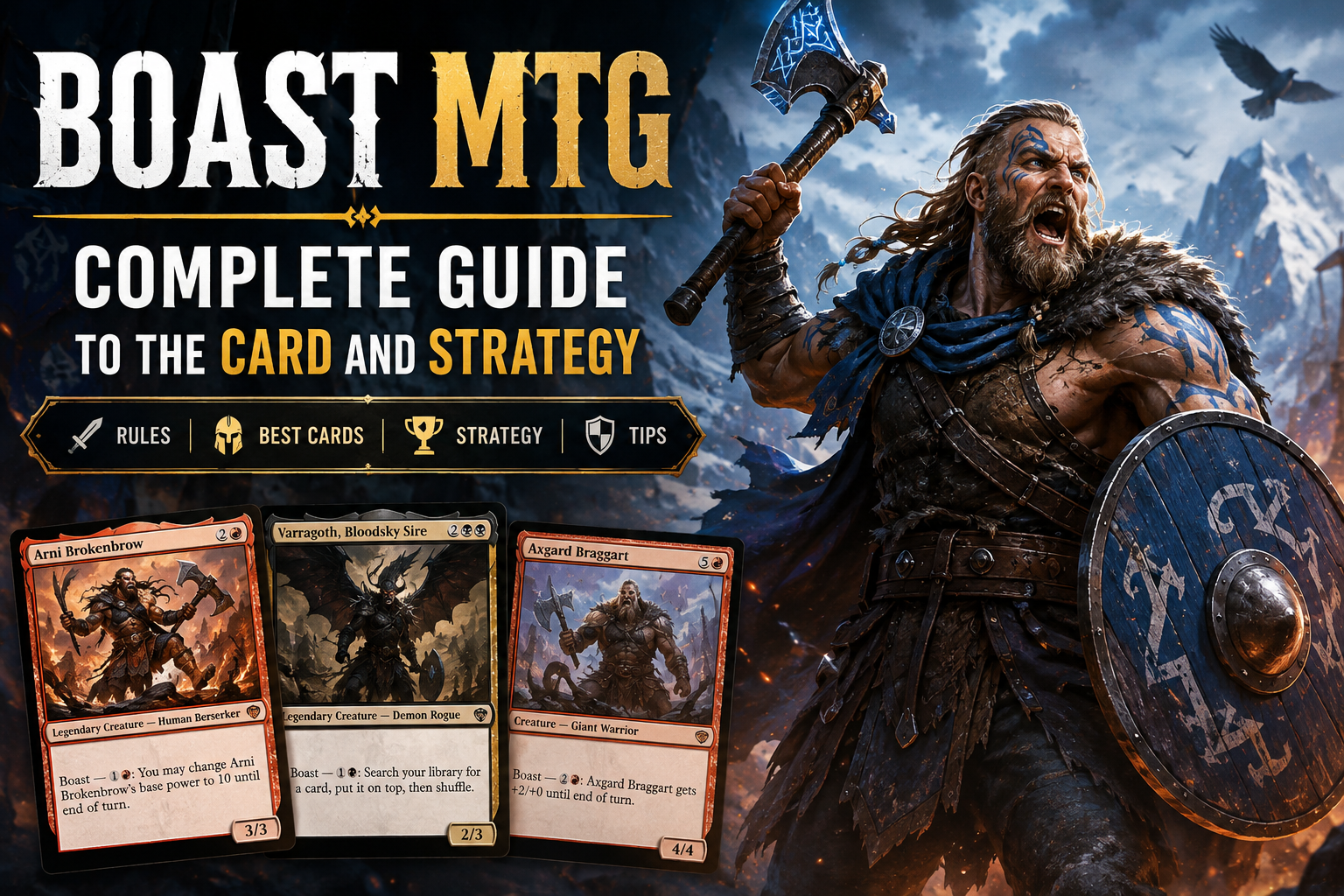
Boast MTG: Complete Guide to the Card and Strategy
Introduction
Boast MTG is one of the most interesting combat-focused mechanics introduced in Magic: The Gathering. First appearing in the Kaldheim set, Boast rewards aggressive gameplay by giving creatures additional abilities after they attack. Unlike many combat mechanics, Boast requires careful planning because timing, mana management, and battlefield awareness all play important roles.
Whether you’re a new player learning the rules or a veteran looking to maximize your deck’s efficiency, understanding how Boast works can significantly improve your gameplay. This guide explains the mechanic in detail, covers the official rules, highlights notable Boast cards, discusses deck-building strategies, and answers common questions players have about the ability.
Key Takeaways
- Boast is an activated ability introduced in Kaldheim.
- A creature must attack before its Boast ability can be activated.
- Each creature can activate its Boast ability only once per turn.
- Successful Boast decks combine aggressive attacks with efficient mana usage.
- Timing your attacks and protecting key creatures are essential for maximizing value.
Main Article
What Is Boast MTG?
Boast is a keyword ability found on certain creatures in Magic: The Gathering. It represents an activated ability that becomes available only after the creature has attacked during the current turn.
Unlike triggered abilities that activate automatically, Boast requires the player to pay its activation cost manually.
A typical Boast ability appears like this:
Boast — Cost: Effect. (Activate only if this creature attacked this turn and only once each turn.)
This wording creates two important restrictions:
- The creature must have attacked.
- The ability can only be activated once each turn.
These limitations encourage thoughtful combat rather than automatic value generation.
How Boast Works
Understanding the sequence is essential.
Step 1: Declare Attackers
During your combat phase, declare your creature with Boast as an attacker.
The creature does not need to deal combat damage.
Simply attacking fulfills the first requirement.
Step 2: Maintain Priority
After attackers are declared, players receive priority.
At this point, if the creature is still on the battlefield, you may activate its Boast ability by paying the required mana or other activation costs.
Step 3: Resolve the Ability
Once activated, the Boast effect goes onto the stack.
If opponents do not counter or otherwise respond successfully, the ability resolves normally.
Important Rules to Remember
Many new players misunderstand Boast. These are the official gameplay principles.
| Rule | Explanation |
|---|---|
| Creature must attack | It only needs to be declared as an attacker. |
| Combat damage is unnecessary | The ability works even if the creature is blocked. |
| Activate once each turn | Each creature’s Boast ability has this limitation. |
| Mana cost required | Every Boast ability has an activation cost. |
| Uses the stack | Opponents may respond before it resolves. |
Why Was Boast Introduced?
Kaldheim draws inspiration from Norse mythology, where warriors sought glory through heroic deeds.
Boast reflects this flavor by rewarding creatures that enter battle before demonstrating their special abilities.
Rather than encouraging passive play, Boast promotes attacking while still rewarding careful decision-making.
Best Boast MTG Cards
Several cards helped define the mechanic during the Kaldheim Standard environment.
Arni Brokenbrow
Arni can temporarily increase his power after attacking, allowing explosive combat turns.
Best for:
- Aggressive red decks
- Midrange combat strategies
- Damage-focused builds
Egon, God of Death
Although known for graveyard interactions, Egon’s Boast synergy complements black aggressive decks.
Varragoth, Bloodsky Sire
One of the strongest Boast creatures ever printed.
Its Boast ability allows you to tutor a card to the top of your library, giving tremendous consistency.
Excellent in:
- Commander
- Casual decks
- Toolbox strategies
Axgard Braggart
This giant warrior can continuously grow larger through repeated Boast activations.
Ideal for games that last several turns.
Strengths of the Boast Mechanic
Boast offers several advantages compared to traditional combat abilities.
Flexible Decision Making
Unlike attack triggers, Boast lets players decide whether using mana immediately is worthwhile.
Sometimes saving mana for removal or interaction is the stronger play.
Encourages Skillful Combat
Players must evaluate:
- Blocking scenarios
- Opponent’s available mana
- Potential removal spells
- Future turns
Excellent Flavor
Mechanically and thematically, Boast fits the Viking-inspired setting exceptionally well.
Weaknesses of Boast
Although powerful, the mechanic has limitations.
Requires Attacking
If attacking is impossible due to unfavorable board states, Boast cannot be activated.
Mana Intensive
Many Boast abilities require additional mana investment.
This creates difficult choices between:
- Casting another spell
- Activating Boast
- Holding interaction
Vulnerable to Removal
An opponent can remove the creature before the Boast ability is activated.
Protecting important creatures becomes essential.
Building a Boast Deck
Successful Boast decks share several characteristics.
1. Efficient Creatures
Choose creatures that can attack safely.
Evasive abilities such as:
- Flying
- Menace
- Trample
- First Strike
make Boast creatures more reliable.
2. Mana Curve
Avoid overcrowding expensive spells.
Because Boast requires activation costs, lower-cost spells help keep mana available.
3. Combat Tricks
Instant-speed spells improve combat outcomes while protecting valuable attackers.
Examples include:
- Pump spells
- Protection spells
- Removal
- Combat tricks
4. Card Advantage
Since Boast often consumes mana every turn, additional card draw helps maintain momentum.
Boast vs Other Combat Mechanics
| Mechanic | Requires Attack | Automatic | Activation Cost |
|---|---|---|---|
| Boast | Yes | No | Yes |
| Exert | Yes | Yes | No |
| Battalion | Yes | Yes | No |
| Raid | Yes | Sometimes | No |
| Prowess | No | Yes | No |
Boast stands apart because players choose exactly when to activate the ability.
That flexibility creates additional strategic depth.
Best Formats for Boast
Standard (Historical)
Boast played a meaningful role during the Kaldheim Standard format.
Commander
Some Boast creatures remain popular because repeatable activated abilities scale well in multiplayer games.
Casual Play
Kitchen-table Magic offers plenty of opportunities to enjoy Boast mechanics without highly optimized competition.
Tips for Playing Boast Successfully
Experienced players often follow these strategies.
Attack First, Plan Later
Sometimes attacking with multiple creatures forces awkward blocks before activating Boast.
Preserve Mana
Avoid spending all your mana before combat if your Boast creature is likely to attack.
Read Opponent Responses
If your opponent leaves untapped mana available, consider whether activating Boast immediately is worth the risk.
Build Around Synergy
Cards that generate extra mana, untap creatures, or increase combat pressure naturally support Boast strategies.
Common Mistakes
Many players lose value by making avoidable errors.
Activating Too Early
Sometimes waiting until after blockers or additional combat decisions provides better information.
Ignoring Mana Efficiency
Activating Boast every turn is not always optimal.
Choose the highest-value play.
Overextending
Attacking recklessly simply to enable Boast can leave you vulnerable to unfavorable trades.
Example Turn
Imagine controlling Varragoth, Bloodsky Sire.
- Begin combat.
- Declare Varragoth as an attacker.
- Opponent chooses not to block.
- Before combat damage ends, activate Boast.
- Pay the activation cost.
- Search your library and place the chosen card on top.
- Draw that card on your next turn.
This simple sequence demonstrates why Boast rewards careful planning.
Is Boast Still Relevant Today?
Although newer mechanics continue to enter Magic: The Gathering, Boast remains enjoyable because it encourages interactive gameplay rather than automatic value.
Commander players still use several Boast creatures, especially those with repeatable utility effects.
For collectors and casual players, Kaldheim remains one of the most flavorful sets, and Boast is a major reason why.
Frequently Asked Questions
What does Boast mean in MTG?
Boast is an activated ability that can only be used if the creature attacked during the current turn, and only once each turn.
Does a Boast creature need to deal combat damage?
No. Declaring the creature as an attacker is enough to enable the ability.
Can Boast be activated multiple times?
No. Each Boast ability may only be activated once each turn, even if additional combat phases occur.
Can I activate Boast after combat?
Yes. As long as the creature attacked during that turn and remains on the battlefield, you may activate its Boast ability at an appropriate time while you have priority.
Can opponents respond to a Boast ability?
Yes. Because Boast is an activated ability that uses the stack, opponents can respond with removal, counterspells that affect abilities, or other instant-speed effects.
Is Boast good in Commander?
Some Boast creatures, particularly those offering repeatable value like Varragoth, Bloodsky Sire, are strong additions to Commander decks that can consistently attack.
Conclusion
Boast MTG is a well-designed combat mechanic that blends strategic decision-making with flavorful gameplay. Instead of rewarding attacks automatically, it asks players to think carefully about combat timing, mana management, and long-term planning. Whether you’re building an aggressive deck, experimenting with Kaldheim cards, or simply learning how the mechanic works, mastering Boast can make your games more engaging and rewarding.
By understanding the rules, choosing the right creatures, and recognizing the best moments to activate Boast abilities, you’ll be better equipped to take full advantage of one of Magic: The Gathering‘s most distinctive combat mechanics.