
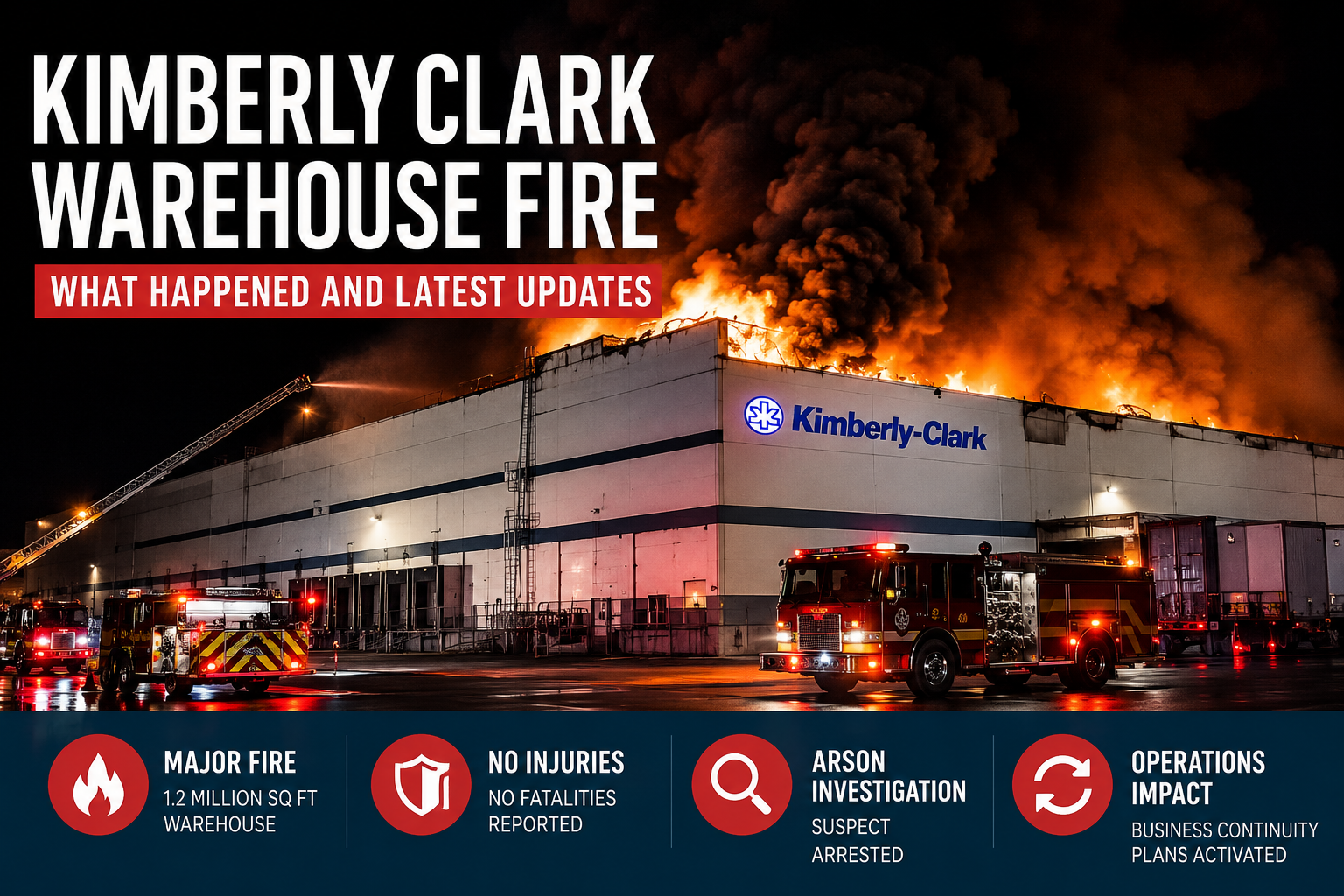
Kimberly Clark Warehouse Fire: What Happened and Latest Updates
The Kimberly Clark Warehouse Fire became one of the most significant industrial fire incidents of 2026 after a massive blaze destroyed a major distribution warehouse in Ontario, California. The event attracted widespread attention because of the size of the facility, the emergency response it required, and the potential impact on Kimberly-Clark’s supply chain.
As information emerged, many people searched for answers about what caused the fire, whether anyone was injured, how authorities responded, and what the incident means for customers and local communities.
This article explains the Kimberly Clark Warehouse Fire in clear, factual terms. It covers the timeline of events, the ongoing investigation, the operational impact, and the latest developments while separating confirmed facts from speculation.
Key Takeaways
- The Kimberly Clark Warehouse Fire occurred at a large distribution warehouse in Ontario, California.
- The fire required a six-alarm emergency response involving approximately 175 firefighters.
- No fatalities or responder injuries were reported during the incident.
- Authorities launched an arson investigation, and a suspect was arrested shortly after the fire.
- Kimberly-Clark stated that manufacturing operations were not directly affected, although the company activated contingency plans to minimize supply disruptions.
Main Article
What Was the Kimberly Clark Warehouse Fire?
The Kimberly Clark Warehouse Fire occurred during the early hours of April 7, 2026, at a large distribution center on Hellman Avenue in Ontario, California. The facility stored Kimberly-Clark paper products, including household tissue products, and served as an important logistics hub for regional distribution.
Fire crews responded shortly after midnight after receiving reports of a rapidly growing commercial structure fire.
According to local officials, the warehouse covered approximately 1.2 million square feet, making it one of the larger warehouse fires experienced in the region in recent years.
Timeline of the Incident
| Time | Event |
|---|---|
| Shortly after 12:30 a.m. | Fire reported at the warehouse |
| Initial response | Firefighters began an interior attack |
| Fire intensified | Crews withdrew due to rapid fire growth |
| Six-alarm response | Additional fire agencies joined the operation |
| Later that day | Fire contained to the building of origin |
| Following investigation | Suspect arrested on arson-related charges |
The fire spread rapidly because the warehouse contained large quantities of paper-based products, which significantly increased the available fuel load.
How Firefighters Responded
Emergency responders quickly recognized the scale of the incident.
The Ontario Fire Department initially attempted an interior attack but transitioned to a defensive strategy after flames spread rapidly throughout the building. Large master stream apparatus were used to attack the fire from outside the structure.
The emergency response eventually involved:
- Around 175 firefighters
- Multiple neighboring fire departments
- More than 20 engine companies
- Specialized fire investigation teams
- Police support for traffic management and investigation
Officials later confirmed the fire was contained to the warehouse despite the building becoming a total loss.
Was Anyone Injured?
One of the most positive outcomes of the Kimberly Clark Warehouse Fire was that no deaths or responder injuries were reported.
Employees were evacuated safely, and authorities confirmed that the individual initially believed to be missing had been located.
Large warehouse fires can pose serious risks because of:
- Heavy smoke
- Structural collapse
- Rapid flame spread
- Falling debris
- Heat exposure
Avoiding injuries during an incident of this magnitude was considered a significant success for emergency responders.
What Caused the Fire?
Investigators treated the incident as a suspected case of arson.
Authorities later announced the arrest of a 29-year-old employee of NFI Industries, the third-party logistics company operating the warehouse for Kimberly-Clark. Prosecutors filed arson-related charges as the investigation continued. At the time of reporting, the legal process was ongoing, and the allegations had not been adjudicated in court.
As with any criminal investigation, official findings may evolve as additional evidence is reviewed.
Understanding the Warehouse’s Role
Although commonly referred to as a Kimberly-Clark warehouse, the building primarily served as a distribution center rather than a manufacturing plant.
Its primary functions included:
- Receiving finished products
- Temporary storage
- Regional distribution
- Supply chain logistics
- Shipment coordination
Kimberly-Clark later clarified that manufacturing facilities were not affected by the fire because production occurred elsewhere.
Impact on Kimberly-Clark Operations
Whenever a major distribution center is lost, businesses must quickly adapt.
Following the incident, Kimberly-Clark announced several actions, including:
- Activating business continuity plans
- Redirecting shipments
- Securing alternative warehouse capacity
- Working with logistics partners
- Minimizing disruption to retailers and consumers
The company also stated that it maintained insurance coverage for property damage and business interruption.
Could Consumers Experience Product Shortages?
Immediately after the fire, many consumers wondered whether products such as toilet paper, facial tissues, and paper towels would become difficult to find.
While temporary logistical challenges were possible, Kimberly-Clark emphasized that its broader supply chain network was designed to maintain continuity during disruptions by shifting inventory and using alternative storage locations.
The actual impact on consumers depends on factors such as:
- Existing inventory levels
- Transportation capacity
- Retail demand
- Distribution adjustments
Investigation and Legal Proceedings
Following the fire, investigators from multiple agencies worked together to determine exactly how the incident occurred.
The investigation involved:
- Fire investigators
- Ontario Police Department
- Prosecutors
- Evidence collection
- Review of digital evidence
- Witness interviews
Authorities asked anyone with additional information to contact investigators while the case remained active.
Community Impact
Large industrial fires affect more than the businesses involved.
Nearby residents experienced:
- Temporary road closures
- Smoke concerns
- Noise from firefighting operations
- Ongoing demolition work
- Increased emergency activity
In the weeks after the incident, city officials provided updates regarding debris removal, demolition, and site cleanup to keep nearby residents informed.
Lessons from the Kimberly Clark Warehouse Fire
Although investigations determine the exact cause of individual incidents, warehouse fires generally highlight several important safety considerations.
Organizations often review:
- Fire prevention systems
- Employee safety training
- Emergency evacuation procedures
- Warehouse monitoring
- Inventory storage practices
- Security measures
- Business continuity planning
Major incidents frequently lead companies to reassess operational risks and strengthen emergency preparedness.
Latest Updates
The most recent official updates indicate that:
- The warehouse was declared a total loss.
- Demolition and cleanup activities have been progressing.
- Criminal proceedings related to the arson allegations are continuing.
- Kimberly-Clark has implemented supply chain mitigation measures.
- Authorities continue to process evidence as part of the investigation.
Frequently Asked Questions
Where did the Kimberly Clark Warehouse Fire happen?
The fire occurred at a Kimberly-Clark distribution warehouse on Hellman Avenue in Ontario, California.
Was anyone killed in the Kimberly Clark Warehouse Fire?
No. Authorities reported no deaths and no responder injuries during the incident.
What caused the Kimberly Clark Warehouse Fire?
Authorities investigated the fire as suspected arson and arrested a third-party logistics employee. Criminal proceedings remain ongoing.
Did the fire affect Kimberly-Clark manufacturing?
According to Kimberly-Clark, manufacturing facilities were not impacted because the affected site functioned as a distribution warehouse.
Will the fire affect product availability?
The company activated contingency plans and alternative logistics arrangements to reduce disruption, although localized distribution impacts were possible.
How large was the warehouse?
Officials reported that the facility covered approximately 1.2 million square feet, making it one of the largest warehouse structures in the area.
Conclusion
The Kimberly Clark Warehouse Fire was a major industrial incident that required an extensive emergency response and resulted in the complete loss of a large distribution facility. Fortunately, no lives were lost, and emergency crews successfully contained the fire to the warehouse.
As the legal investigation continues, the incident serves as a reminder of the importance of fire prevention, emergency planning, and resilient supply chains. Kimberly-Clark has stated that it is working to maintain product availability through alternative logistics arrangements while local authorities complete their investigation and the site recovery progresses.