
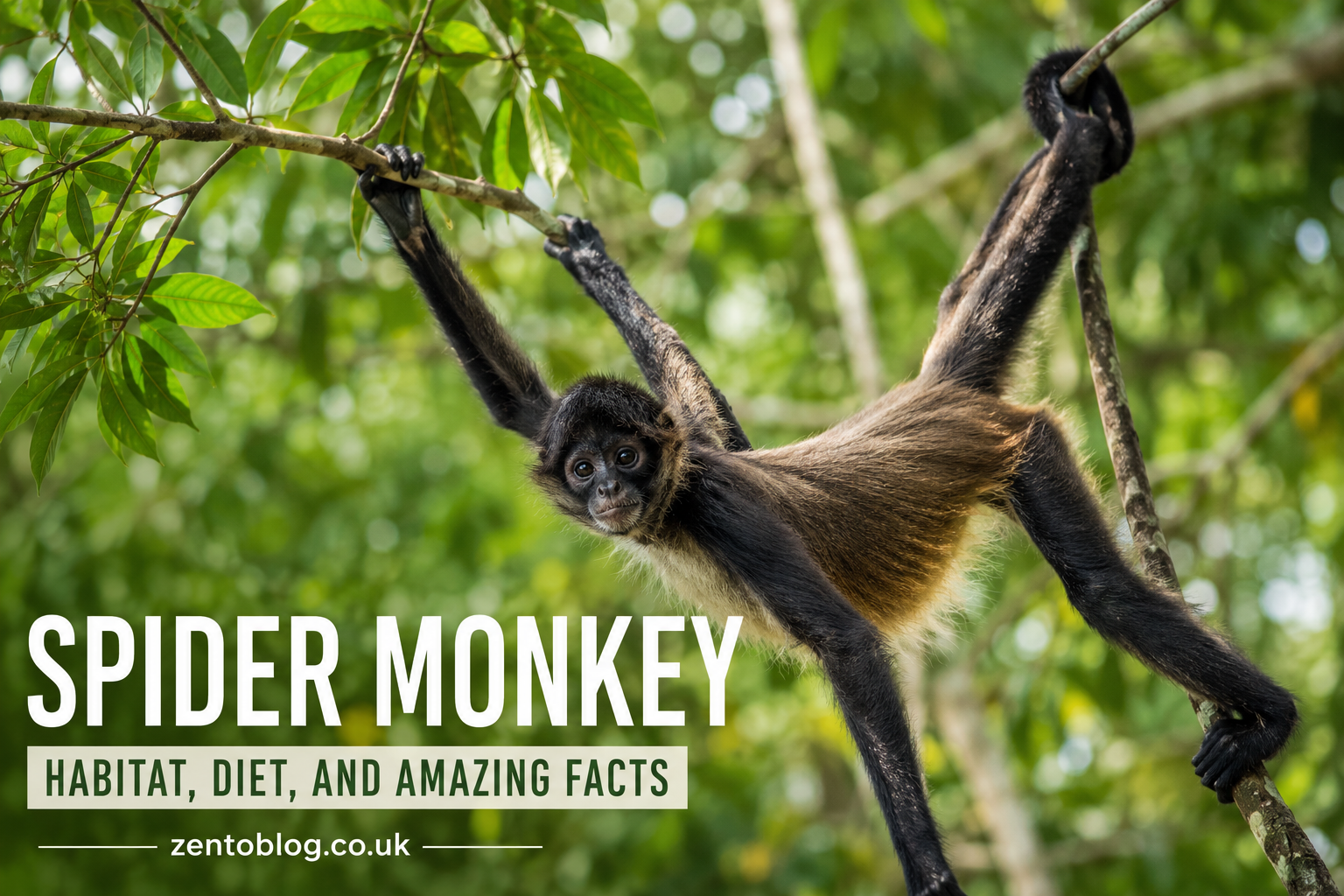
Spider Monkey: Habitat, Diet, and Amazing Facts
The Spider Monkey is one of the most fascinating primates in the Americas. Known for its long limbs, remarkable agility, and prehensile tail, this intelligent animal spends most of its life high in the forest canopy. Its unique appearance and social behavior have made it a favorite subject for wildlife enthusiasts, researchers, and conservationists alike.
Despite their incredible climbing abilities, spider monkeys face growing threats from habitat destruction, hunting, and illegal wildlife trade. Understanding how these primates live, what they eat, and why they are important to tropical ecosystems can help raise awareness about their conservation.
This guide explores everything you need to know about the spider monkey, including its habitat, diet, physical characteristics, behavior, reproduction, lifespan, natural predators, and conservation challenges.
Key Takeaways
- Spider monkeys are highly intelligent primates native to Central and South America.
- Their long, prehensile tail functions almost like a fifth limb for climbing.
- They mainly eat fruit but also consume leaves, flowers, seeds, and insects.
- Spider monkeys play a vital role in forest regeneration by dispersing seeds.
- Habitat loss and hunting have placed several spider monkey species at risk.
Main Article
What Is a Spider Monkey?
A spider monkey is a member of the genus Ateles, a group of New World monkeys found in tropical forests throughout Central and South America. Their name comes from their exceptionally long arms, legs, and tail, which give them a spider-like appearance when hanging from tree branches.
Unlike many primates, spider monkeys rarely spend time on the ground. They are perfectly adapted for life in the treetops, where they travel quickly in search of food and avoid many ground-based predators.
Physical Characteristics
Spider monkeys have several unique features that distinguish them from other monkeys.
| Feature | Description |
|---|---|
| Scientific Genus | Ateles |
| Average Body Length | 35–66 cm (14–26 inches) |
| Tail Length | Up to 89 cm (35 inches) |
| Average Weight | 6–11 kg (13–24 pounds) |
| Lifespan | 20–27 years in the wild; longer in captivity |
| Tail | Fully prehensile with a gripping tip |
| Diet | Mostly fruit (frugivorous) |
Their most remarkable feature is their prehensile tail, which acts almost like an extra hand. The underside of the tail has a sensitive, hairless patch that allows it to grip branches securely while climbing or feeding.
Where Do Spider Monkeys Live?
Spider monkeys inhabit tropical rainforests from southern Mexico through Central America and into northern South America.
Preferred Habitat
They thrive in:
- Tropical rainforests
- Evergreen forests
- Cloud forests
- Mangrove forests
- Lowland forests
Spider monkeys spend nearly all of their lives in the forest canopy, often more than 20 meters above the ground.
Countries Where They Are Found
Their natural range includes:
- Mexico
- Belize
- Guatemala
- Honduras
- Nicaragua
- Costa Rica
- Panama
- Colombia
- Ecuador
- Peru
- Bolivia
- Brazil
- Venezuela
Healthy forests with abundant fruit-bearing trees are essential for their survival.
Spider Monkey Diet
Spider monkeys are primarily fruit eaters, making fruit the foundation of their diet throughout most of the year.
Common Foods
They commonly eat:
- Ripe fruits
- Figs
- Berries
- Leaves
- Flowers
- Seeds
- Nuts
- Bark
- Insects
- Bird eggs (occasionally)
Fruit can account for more than 80% of their diet during seasons when it is plentiful.
Why Their Diet Matters
Spider monkeys help maintain healthy forests by spreading seeds through their droppings. Many tropical tree species rely on animals like spider monkeys for seed dispersal, making these primates essential contributors to forest regeneration.
Behavior and Intelligence
Spider monkeys are among the most intelligent New World monkeys.
They demonstrate:
- Excellent problem-solving skills
- Strong spatial memory
- Complex social interactions
- Advanced communication
- Cooperative behavior
Their ability to remember the locations of fruiting trees helps them travel efficiently across large forest areas.
Daily Activities
A typical day includes:
- Searching for food.
- Traveling through the canopy.
- Grooming companions.
- Resting during the hottest hours.
- Socializing with other group members.
They can travel several kilometers each day while searching for ripe fruit.
Social Structure
Spider monkeys live in flexible social groups known as fission-fusion societies.
Instead of remaining together all day, a large troop divides into smaller groups depending on food availability. These smaller groups later reunite.
This social system reduces competition for food while maintaining strong social bonds.
Communication
Spider monkeys communicate using several methods.
Vocal Sounds
They produce:
- Whinnies
- Barks
- Screeches
- High-pitched calls
These sounds help maintain contact in dense forests.
Body Language
Communication also involves:
- Facial expressions
- Tail movements
- Grooming
- Physical touch
- Branch shaking
Together, these behaviors strengthen relationships within the group.
Amazing Adaptations
Spider monkeys possess several remarkable adaptations for life in the trees.
Prehensile Tail
Their tail provides:
- Balance
- Support
- Grip
- Stability while feeding
The tail is often capable of supporting the monkey’s full body weight.
Long Limbs
Their unusually long arms allow them to swing efficiently between branches using a form of movement called brachiation.
Hook-Like Hands
Spider monkeys have reduced thumbs, allowing their hands to function like hooks that grip branches securely.
These adaptations make them some of the fastest and most agile primates in tropical forests.
Reproduction and Life Cycle
Female spider monkeys usually give birth to one infant every two to four years.
Infant Development
Young spider monkeys:
- Ride on their mother’s stomach after birth.
- Later move to her back.
- Learn climbing skills through observation.
- Stay with their mother for several years.
This long period of parental care helps young monkeys develop the skills needed to survive.
Natural Predators
Although adults spend most of their lives high in the canopy, they still face natural threats.
Predators include:
- Jaguars
- Ocelots
- Harpy eagles
- Large snakes
- Humans
Young spider monkeys are especially vulnerable.
Different Species of Spider Monkey
Scientists recognize several species within the genus Ateles.
Some well-known examples include:
| Species | Common Name |
|---|---|
| Ateles geoffroyi | Geoffroy’s Spider Monkey |
| Ateles belzebuth | White-bellied Spider Monkey |
| Ateles hybridus | Brown Spider Monkey |
| Ateles chamek | Black-faced Black Spider Monkey |
| Ateles paniscus | Red-faced Spider Monkey |
Several of these species are considered endangered because of habitat destruction.
Why Spider Monkeys Are Important
Spider monkeys play a significant ecological role.
Seed Dispersal
As they consume fruit across large territories, they spread seeds over long distances.
This process:
- Promotes forest regeneration
- Increases plant diversity
- Supports healthy ecosystems
Without animals like spider monkeys, many tree species would struggle to reproduce naturally.
Conservation Status
Many spider monkey populations have declined dramatically.
Major Threats
The biggest threats include:
- Deforestation
- Agricultural expansion
- Logging
- Hunting
- Illegal pet trade
- Habitat fragmentation
The loss of mature forests reduces both food sources and safe travel routes.
Conservation Efforts
Organizations and governments are working to protect spider monkeys through:
- Protected national parks
- Forest restoration
- Wildlife corridors
- Anti-poaching programs
- Community education
- Sustainable forest management
Protecting tropical forests benefits not only spider monkeys but thousands of other species that share the same habitat.
Spider Monkey vs. Howler Monkey
| Feature | Spider Monkey | Howler Monkey |
|---|---|---|
| Tail | Fully prehensile | Fully prehensile |
| Main Diet | Fruit | Leaves |
| Movement | Fast and agile | Slower climbing |
| Social Calls | Moderate | Extremely loud |
| Habitat | Upper canopy | Canopy and mid-level trees |
Both species are important rainforest inhabitants, but they occupy different ecological niches.
Interesting Spider Monkey Facts
- Spider monkeys have no functional thumbs.
- Their tail is strong enough to support their entire body.
- They rarely descend to the forest floor.
- They can leap several meters between branches.
- Fruit often makes up over 80% of their diet.
- They are among the most intelligent New World primates.
- Their social groups frequently split and reunite throughout the day.
- Healthy spider monkey populations indicate a healthy tropical forest ecosystem.
Frequently Asked Questions
1. Why is it called a spider monkey?
The name comes from its long arms, legs, and tail, which resemble the shape of a spider when the monkey hangs from tree branches.
2. What do spider monkeys eat?
Spider monkeys mainly eat ripe fruit but also consume leaves, flowers, seeds, nuts, insects, and occasionally bird eggs.
3. Where do spider monkeys live?
They inhabit tropical forests throughout Central and South America, spending most of their lives high in the forest canopy.
4. Are spider monkeys endangered?
Several species are classified as endangered or critically endangered due to habitat loss, hunting, and illegal wildlife trade.
5. How long do spider monkeys live?
They generally live 20 to 27 years in the wild and may live even longer under professional care.
6. Why is the spider monkey’s tail so important?
Its prehensile tail acts like an extra limb, helping it climb, balance, and safely move through the forest canopy.
7. Are spider monkeys friendly to humans?
Spider monkeys are naturally curious but remain wild animals. They should not be kept as pets because they require complex social groups, large forest habitats, and specialized care.
Conclusion
The Spider Monkey is one of the rainforest’s most remarkable primates, combining intelligence, agility, and unique physical adaptations that make it perfectly suited for life in the treetops. Its prehensile tail, fruit-based diet, and complex social behavior distinguish it from many other monkey species while also making it an essential contributor to healthy tropical ecosystems.
Unfortunately, habitat destruction and other human activities continue to threaten spider monkey populations across their natural range. Protecting forests and supporting conservation efforts are essential steps toward ensuring these extraordinary primates continue to thrive. By understanding their role in nature, we gain a greater appreciation for the delicate balance of tropical ecosystems and the importance of preserving them for future generations.