
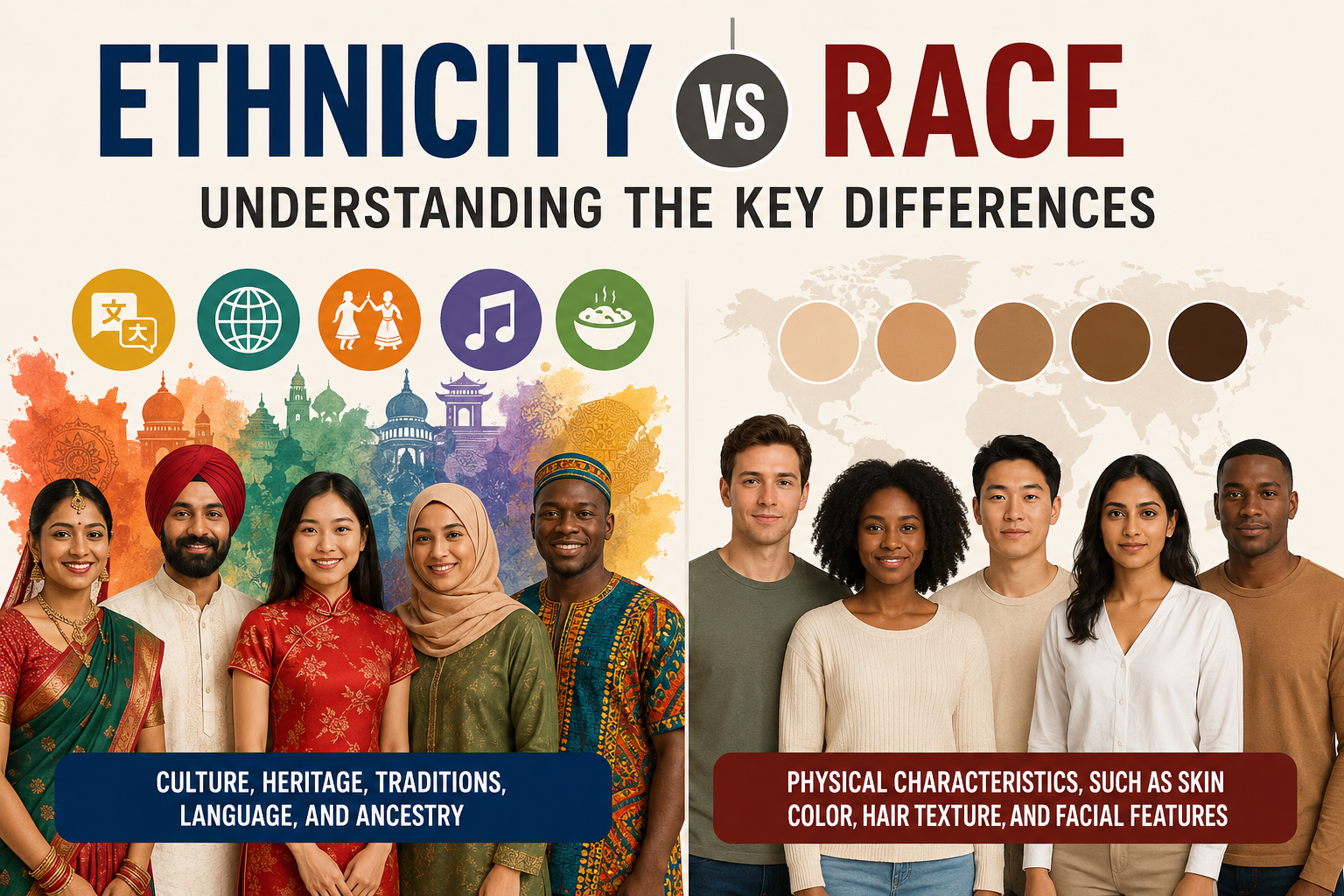
Ethnicity vs Race: Understanding the Key Differences
The topic of Ethnicity vs Race often creates confusion because the two terms are frequently used interchangeably in everyday conversations. While they are related to identity, they describe different aspects of who people are. Understanding these differences is important not only for accurate communication but also for appreciating cultural diversity and addressing social issues.
Race has traditionally been associated with physical characteristics, while ethnicity focuses on shared culture, heritage, traditions, language, and ancestry. Knowing the distinction helps individuals better understand themselves, respect others, and participate in more informed discussions about identity, history, and society.
This guide explains ethnicity and race in clear, practical terms, explores how they differ, highlights their similarities, and answers common questions people have about these important concepts.
Key Takeaways
- Race and ethnicity describe different aspects of identity.
- Race is commonly linked to physical characteristics, while ethnicity relates to culture, ancestry, and shared traditions.
- A person may identify with multiple ethnicities and races simultaneously.
- Understanding these concepts promotes respectful communication and cultural awareness.
- The meanings of race and ethnicity have evolved over time and continue to vary across societies.
Main Article
What Is Race?
Race is a social classification that has historically grouped people based on visible physical characteristics such as skin color, facial features, and hair texture.
Although race has often been treated as a biological category, modern scientific research shows that humans share overwhelmingly similar genetic makeup. There is more genetic variation within many racial groups than between them.
Today, most scholars describe race as a social construct rather than a strict biological reality. However, race continues to influence people’s experiences because societies often assign meaning to physical differences.
Common Examples of Racial Categories
Depending on the country, racial categories may include:
- Black or African
- White
- Asian
- Native American or Indigenous
- Pacific Islander
These classifications vary widely across different regions and governments.
What Is Ethnicity?
Ethnicity refers to a person’s cultural background and shared heritage.
Unlike race, ethnicity includes characteristics such as:
- Language
- Traditions
- Customs
- Religion
- Family heritage
- National origin
- Shared history
- Cultural practices
Ethnicity often shapes the way people celebrate holidays, prepare food, speak languages, and maintain family traditions.
Examples of Ethnic Groups
Examples include:
- Irish
- Italian
- Arab
- Kurdish
- Punjabi
- Han Chinese
- Yoruba
- Māori
- Hispanic or Latino (depending on context)
- Pashtun
People belonging to the same racial group may have completely different ethnic backgrounds.
Ethnicity vs Race: The Key Differences
The easiest way to understand Ethnicity vs Race is by comparing the characteristics each concept describes.
| Race | Ethnicity |
|---|---|
| Primarily associated with physical appearance | Associated with shared culture and heritage |
| Often assigned by society | Often based on family history and personal identity |
| Social classification | Cultural identification |
| May remain constant throughout life | Can evolve through cultural experiences |
| Includes physical traits | Includes language, traditions, customs, religion, and ancestry |
Although these concepts overlap in some situations, they are not interchangeable.
Why People Confuse Race and Ethnicity
Many forms, surveys, and conversations mention race and ethnicity together without explaining the difference.
Several factors contribute to the confusion:
- Historical changes in terminology
- Different definitions across countries
- Government reporting systems
- Media representation
- Family heritage involving multiple cultures
For example, someone may identify racially as Black while identifying ethnically as Jamaican or Nigerian.
Likewise, another individual may identify racially as Asian while belonging to Chinese, Korean, Japanese, Vietnamese, or Filipino ethnic communities.
Can Someone Have Multiple Ethnicities?
Yes.
Many people come from multicultural families and identify with more than one ethnic background.
For example, someone might have:
- Mexican and Irish ancestry
- Indian and British heritage
- Korean and American cultural influences
Multiple ethnic identities have become increasingly common because of migration and multicultural societies.
Can Race and Ethnicity Change?
The answer depends on which concept is being discussed.
Race
Race is generally assigned according to social definitions and physical characteristics. However, racial identity can also involve personal self-identification, especially in multicultural societies.
Ethnicity
Ethnicity is often more flexible because culture can be learned, preserved, blended, or embraced over time.
For example:
- A child raised in two cultural traditions may identify with both.
- Immigrant families may adopt new cultural customs while maintaining their original heritage.
- Individuals may reconnect with ancestral traditions later in life.
Why Understanding the Difference Matters
Understanding Ethnicity vs Race has practical benefits in everyday life.
Better Communication
Using the correct terms helps avoid misunderstandings and promotes respectful conversations.
Greater Cultural Awareness
Recognizing different ethnic traditions encourages appreciation for cultural diversity.
Improved Research
Researchers studying health, education, economics, or demographics often distinguish between race and ethnicity because each provides different information.
More Inclusive Communities
Understanding identity helps organizations create more inclusive workplaces, schools, and public services.
Real-World Examples
Example 1
A woman identifies as:
- Race: Asian
- Ethnicity: Japanese
Example 2
A man identifies as:
- Race: Black
- Ethnicity: Nigerian
Example 3
Another person identifies as:
- Race: White
- Ethnicity: Italian American
Each example shows that race describes one aspect of identity, while ethnicity provides cultural context.
Ethnicity and Cultural Identity
Ethnicity often plays a significant role in shaping identity throughout life.
It may influence:
- Language spoken at home
- Traditional foods
- Music
- Religious practices
- Family celebrations
- Community involvement
- Cultural values
For many people, ethnicity represents a strong connection to family history and shared experiences.
Race and Society
Although race is considered a social construct, it has had lasting effects on societies around the world.
Historically, racial classifications have influenced:
- Laws
- Education
- Employment
- Housing
- Voting rights
- Immigration policies
Understanding these historical influences helps explain why discussions about race remain important today.
Ethnicity in a Globalized World
Global migration has made many societies increasingly multicultural.
Today, millions of people:
- Speak multiple languages
- Celebrate traditions from different cultures
- Identify with more than one ethnicity
- Grow up in multicultural households
This diversity enriches communities while also encouraging greater understanding of different cultural backgrounds.
Common Myths About Ethnicity vs Race
Myth 1: Race and ethnicity mean the same thing.
They are related but describe different aspects of identity.
Myth 2: Everyone belongs to only one ethnicity.
Many people have multiple ethnic backgrounds.
Myth 3: Ethnicity is determined only by nationality.
Nationality refers to legal citizenship, while ethnicity reflects shared cultural heritage.
Myth 4: Race is purely biological.
Modern science recognizes race primarily as a social concept rather than a strict biological classification.
Myth 5: Ethnicity never changes.
Cultural identity may evolve through migration, family traditions, and personal experiences.
Race, Ethnicity, Nationality, and Ancestry
These four concepts are often confused.
| Term | Meaning |
|---|---|
| Race | Social grouping based largely on physical characteristics |
| Ethnicity | Shared culture, language, traditions, and heritage |
| Nationality | Legal citizenship in a country |
| Ancestry | Family lineage and historical origins |
Understanding these distinctions helps create more accurate discussions about identity.
Why Respecting Identity Matters
Every individual has a unique background.
Respecting how people identify themselves promotes:
- Inclusion
- Equality
- Mutual understanding
- Cultural appreciation
- Stronger communities
Listening to how individuals describe their own identity is often the most respectful approach.
Frequently Asked Questions
1. What is the main difference between ethnicity and race?
Race generally refers to socially recognized physical characteristics, while ethnicity relates to shared cultural heritage, traditions, language, and ancestry.
2. Can two people have the same race but different ethnicities?
Yes. For example, two people may both identify as Asian but belong to different ethnic groups such as Chinese, Korean, or Vietnamese.
3. Is ethnicity based on nationality?
Not necessarily. Nationality refers to citizenship, while ethnicity reflects cultural heritage and shared ancestry.
4. Can someone identify with more than one ethnicity?
Yes. Many individuals have parents or ancestors from different cultural backgrounds and identify with multiple ethnicities.
5. Why are race and ethnicity important in research?
They help researchers understand social trends, health outcomes, education, and demographic patterns while recognizing cultural diversity.
6. Is race a biological concept?
Current scientific understanding suggests that race is primarily a social construct rather than a strict biological classification.
7. Why is it important to understand ethnicity vs race?
Understanding the distinction encourages respectful communication, improves cultural awareness, and helps people better appreciate the diversity of human identities.
Conclusion
Understanding Ethnicity vs Race is essential for anyone seeking a clearer understanding of identity, culture, and society. While race is generally associated with socially recognized physical characteristics, ethnicity reflects the traditions, language, ancestry, and cultural experiences that connect people to their heritage. Recognizing the difference allows for more respectful conversations, greater cultural appreciation, and a deeper understanding of the diverse communities that make up our world. As societies continue to become more interconnected, knowing how race and ethnicity differ—and how they sometimes overlap—helps foster inclusion, empathy, and informed dialogue.